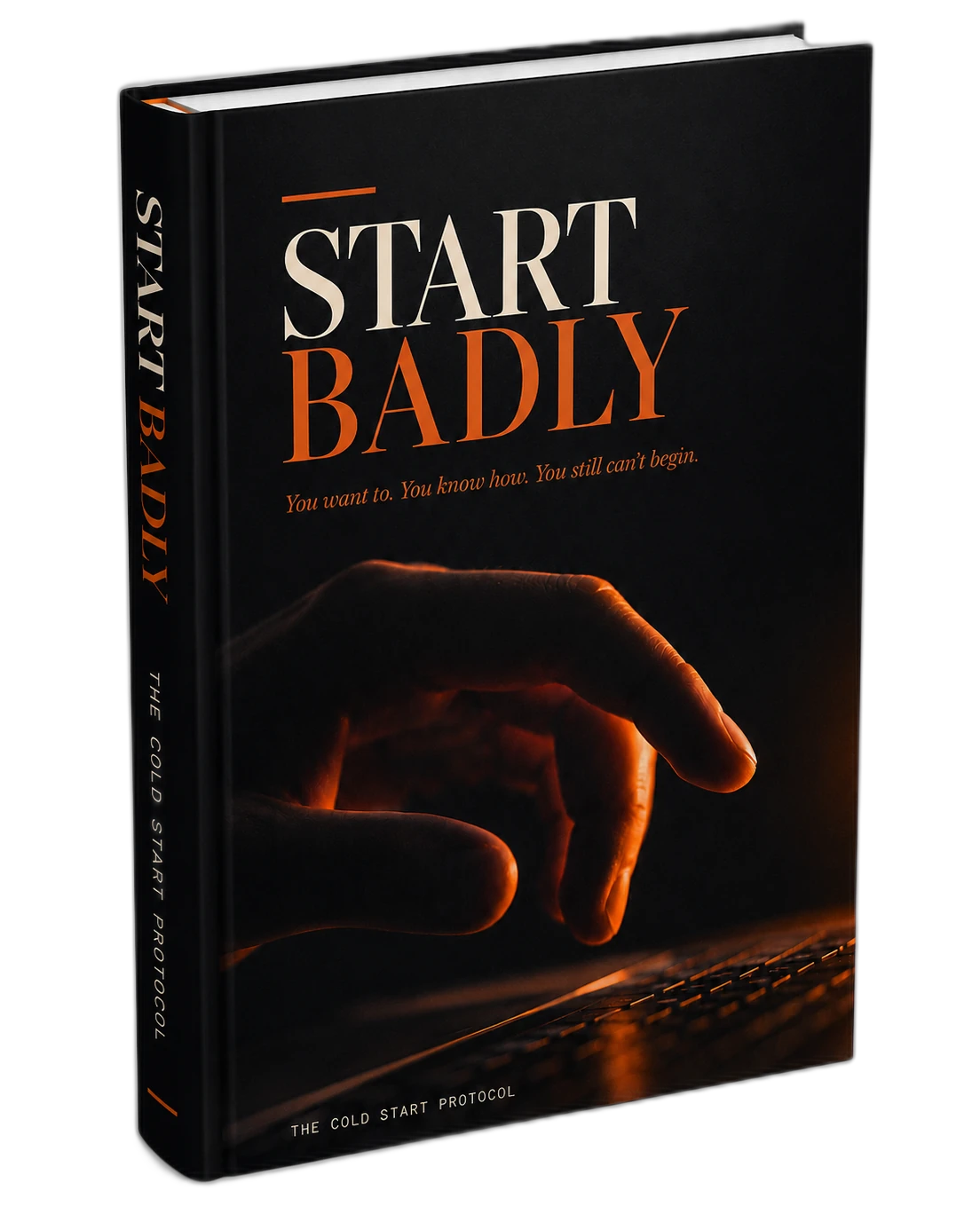
That gap has a mechanism, and it isn't discipline. Start Badly is a 65-page field guide to task paralysis - what's physically happening, and the 90-second protocol that gets you moving.
Not a diagnostic. Just a way to find out whether this book is describing you or someone else.
Capturing, tagging, sorting, rescheduling, clearing the overdue pile - every one of those is an executive-function task. The system spends the exact resource it was supposed to protect. Then it shows you the shortfall in red.
It's new, so it works. Novelty is doing the lifting, not the method. You colour things in and think you've finally solved it.
Novelty wears off. The system still demands maintenance but stops giving anything back.
A bad night, an unexpected demand, a low-capacity Tuesday. Nothing dramatic.
You open it and see three red overdue items. The tool is now a record of failure, so you stop opening it.
Two hours in front of a task you want to do, know how to do, and cannot begin.
The reason this works isn't a better method. It's the absence of maintenance. You can ignore this book for four months and it costs exactly the same to come back to.
Written to be opened badly - at 2pm on a Wednesday, three hours into a freeze. Short chapters, no preamble, and the protocol works without reading the theory first.
Designed to be printed and left where you can see them - because if you can't see it, on a bad day it doesn't exist.
The 90-second protocol on one page, with a tear-off pocket version. For when you can't read anything longer.
Find the small gates stacked in front of a task you keep failing to start, and remove them permanently.
Three modes for three kinds of day, plus a blank low-capacity menu to fill in while you're functional.
Test twelve bridges, keep the ones that work, and write the list you'll need when you can't think of options.
Five steps back after you've dropped everything for a month. No backlog to clear, no explaining required.

Total value: $105 - yours for $29.
This book wasn't assembled from productivity blogs. It came out of years of the specific experience it describes - the eleven-hour deadline sprint, the planner abandoned on day nine, the email left unanswered for a fortnight while it got heavier.
What changed things wasn't a better system. It was understanding that the wall is a threat response, not a character defect, and that the way through it is physical and small rather than motivational and large.
Everything in here has been used on the days it was hardest to use anything.
If a technique needs you to already be functional, it isn't in this book.

If it isn't right for you, email us within 24 hours for a full refund. No questions asked.
It has been for a while. Ninety seconds from now it could be started - badly, incompletely, two minutes' worth. That's still further than it's moved all week.
Get my copy - $29